 Add to Chrome
 Add to Firefox
 Add to Edge
Hy-MT2: A Family of Fast, Efficient and Powerful Multilingual Translation Models in the Wild
May 21, 2026
Hy-MT2 is a family of fast-thinking multilingual translation models designed for complex real-world scenarios. It includes three model sizes: 1.8B, 7B, and 30B-A3B (MoE), all of which support translation among 33 languages and effectively follow translation instructions in multiple languages. For on-device deployment, with AngelSlim 1.25-bit extreme quantization, the 1.8B model requires only 440 MB of storage and improves inference speed by 1.5x. Multi-dimensional evaluations show that Hy-MT2 delivers outstanding performance across general, real-world business, domain-specific, and instruction-following translation tasks. The 7B and 30B models outperform open-source models such as DeepSeek-V4-Pro and Kimi K2.6 in fast-thinking mode, while the lightweight 1.8B model also surpasses mainstream commercial APIs from providers such as Microsoft and Doubao overall.

Diversity or Precision? A Deep Dive into Next Token Prediction
Dec 28, 2025Recent advancements have shown that reinforcement learning (RL) can substantially improve the reasoning abilities of large language models (LLMs). The effectiveness of such RL training, however, depends critically on the exploration space defined by the pre-trained model's token-output distribution. In this paper, we revisit the standard cross-entropy loss, interpreting it as a specific instance of policy gradient optimization applied within a single-step episode. To systematically study how the pre-trained distribution shapes the exploration potential for subsequent RL, we propose a generalized pre-training objective that adapts on-policy RL principles to supervised learning. By framing next-token prediction as a stochastic decision process, we introduce a reward-shaping strategy that explicitly balances diversity and precision. Our method employs a positive reward scaling factor to control probability concentration on ground-truth tokens and a rank-aware mechanism that treats high-ranking and low-ranking negative tokens asymmetrically. This allows us to reshape the pre-trained token-output distribution and investigate how to provide a more favorable exploration space for RL, ultimately enhancing end-to-end reasoning performance. Contrary to the intuition that higher distribution entropy facilitates effective exploration, we find that imposing a precision-oriented prior yields a superior exploration space for RL.
Boost Neural Networks by Checkpoints
Oct 03, 2021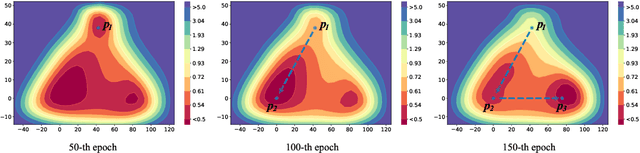
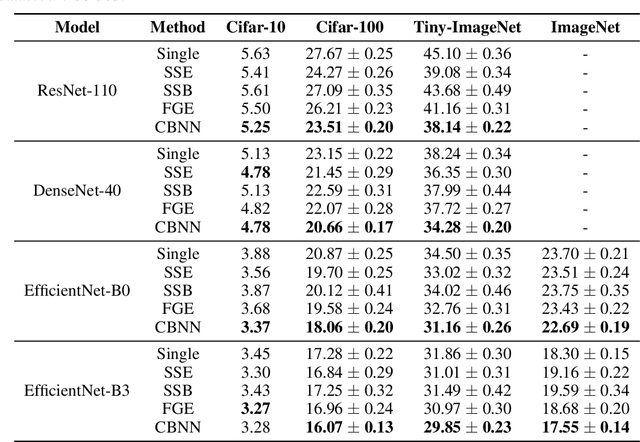
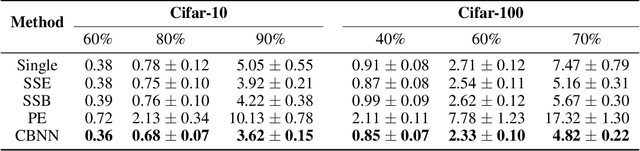
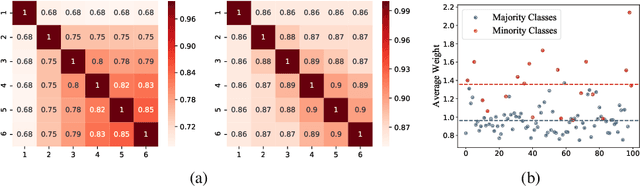
Training multiple deep neural networks (DNNs) and averaging their outputs is a simple way to improve the predictive performance. Nevertheless, the multiplied training cost prevents this ensemble method to be practical and efficient. Several recent works attempt to save and ensemble the checkpoints of DNNs, which only requires the same computational cost as training a single network. However, these methods suffer from either marginal accuracy improvements due to the low diversity of checkpoints or high risk of divergence due to the cyclical learning rates they adopted. In this paper, we propose a novel method to ensemble the checkpoints, where a boosting scheme is utilized to accelerate model convergence and maximize the checkpoint diversity. We theoretically prove that it converges by reducing exponential loss. The empirical evaluation also indicates our proposed ensemble outperforms single model and existing ensembles in terms of accuracy and efficiency. With the same training budget, our method achieves 4.16% lower error on Cifar-100 and 6.96% on Tiny-ImageNet with ResNet-110 architecture. Moreover, the adaptive sample weights in our method make it an effective solution to address the imbalanced class distribution. In the experiments, it yields up to 5.02% higher accuracy over single EfficientNet-B0 on the imbalanced datasets.